Showing posts with label Guest Post. Show all posts

Friday, June 24, 2016

Guest Post: I Feel So Helpless About Orlando

Forty-nine people died early last week.

I live in Michigan, the cul-de-sac of the United States. Nobody comes here unless they meant to,  or else they got lost in Ohio and didn't hit a deer on the way. Our outdoors are great, the beer is fantastic, and the city life is alright if you don't mind driving past an endless field of corn to get to it.

Not much happens here either (at least not in terms of people dying at a mass murderer's hand) and for that I'm both thankful and incomprehensibly pissed off. My life is as safe as it gets; I'm a reasonably young, healthy, straight white adult male who lives in one of the safest cities in one of the safest states in one of the safest countries in one of the safest eras we've ever known.

And yet as fortunate as I am, as fortunate as we all are, forty-nine people's lives were still brutally cut short by intolerance, hatred, bigotry, and violence.

And for that I feel so fucking helpless.

I can't even begin to imagine, in the sheltered womb that is my life, how the LGBTQ community must feel about this. An icy hand of evil has reached up from the past to claim wonderful, innocent souls. Why? No, seriously, why?

Because the people at Pulse committed the horrible, unforgivable crime of loving someone?

Because the people at Pulse were somehow disgusting monsters for having a different identity?

Because the people -- no, wait, that's the whole problem. To this misguided asshat, they weren't people. They were reduced to nothing but their “sins,” deserving only of death, certainly not of mercy. But they were people and they didn't deserve this.

And I feel so fucking helpless because even with all my advantages, I can't personally stop evil from reaching out and striking at a community of people who are beautiful and worthy of life, and yet live in fear.

And I feel helpless because every time something like this happens, social media blows up with so many candles and prayers you'd think there was a PartyLite convention at a church. We all leap to the ramparts to defend our castles of logic and reason, and damn you for being heartless or damn you for trying to solve violence with a vote, or loathing with a law, like it'd actually do anything. Meanwhile, the bodies cool in morgues and I am left feeling helpless in the face of ridiculous, senseless horror.

Some indeterminate time later, the whole cycle starts anew, because not enough of us personally reached out past our keyboards to damn well do anything to help.

Look, my position is pretty clear, and it's trying to fix a problem like hatred and bigotry with a politician's pen is like trying to put out a fire by yelling at it. If you do nothing to address the source of the fire, you've done nothing to remove its effects. Banning objects to control behavior doesn't fucking work and you all know it, because it didn't work for alcohol and it didn't work for drugs and it didn't work for guns and just knock it off already! And yeah, I know we're all making a lot of noise about banning people now, too, but the Internet has no borders and that isn't going to work either. Hell, it didn't even work when the Internet didn't exist. If you want to know more, look up the Japanese internment camps. What a godawful legacy that was.

My position is also pretty clear on how I feel about the LGBTQ community, or at least I hope it is: people are all wonderful, complex, flawed and fantastic, all at the same time. I'm not some paragon of virtuous thinking, but it never made any good sense to me to hate a person for what they are or who they love. We are all weird, wounded, and wild, and if I have any right to life and happiness, so do you, no matter who “you” are.

Assuming you're not the asshole who murdered forty-nine fabulous people, that is. I hope you saw the truth of things before you perished, you miserable moron, but I don't regret or mourn you. You ran out of chances, you misguided and stupid person, when you murdered another.

That's right, even the killer is a person. Not because he's done anything special to deserve it, but because if we dehumanize even the worst of us, we risk dehumanizing the least of us. And that leads only to more of the violence we saw on Sunday. I won't perpetuate it.

Despite how I feel, though I'm not helpless. Not really. And for that, I am profoundly grateful.

Instead of another long virtue-signaling diatribe or stupid meme about what “should be” or how nobly offended I am about what just happened, I can actually do something. We have a tremendous surplus of speech, but we also have a terrible deficit of action. If any of the actions I'm taking today do anything at all to help, then I'm more lucky than I have any right to be. And if just one life is spared by my efforts then it's more than I could hope or dream.

I'm donating blood tomorrow, because wounded people keep needing blood and they can damn well have every drop I don't need right now. I couldn't do it earlier because my schedule sucks and so do donation center hours, but I'll get there tomorrow, probably right around the time they'd actually need some more to replace what was used. Lucky them, I'm O+ and that's a popular flavor.

I found out you can't easily donate to the Pink Pistols, but you can volunteer your time, and that'll have to do for now. Even a straight guy can pass out flyers, even if they're suuuuuper pink. Or I can help teach people who want to defend themselves. I'm not saying they should have to, or that it's their fault if they don't. I'm just saying if they want to, I'll damn well help where I can.

I've joined the Michigan Coalition for Responsible Gun Owners to improve the rights for people in my state to protect their lives however they wish, and I was one of the first 50 people to sign up for Operation Blazing Sword. Human life is a tremendously valuable thing, and it's worth protecting in whatever way is needed. If a good, law-abiding person chooses a firearm to do so, then I'm going to work harder to make that possible for them. There's no good reason the least advantaged of us should suffer at the hands of those most advantaged. And I'm not just chucking money at them, either; I'm going to volunteer my time, any time that the Pink Pistols, if they'll have me, don't consume.

I will seek out more training not just to defend life, but also to preserve it. I will train harder to defend against violence and also to save a life if it happens to myself or another.

I will strive to make my life, my home, my words and my actions a true “safe space” for people who need it. I'm not talking about what the phrase “safe space” has become these days; I'm talking about what it used to mean many years ago. I promise that if you are gay, trans, whatever; my home, my car, my office, even my shoulder, is a place you can go for refuge if you are in danger. Because you are a person and you have value.

Most importantly though, I will speak and act against hatred, against bigotry, against intolerance. No person should fear for their lives based on who they are or who they love. I promise I will stand against hate by speaking out against it, not just on Facebook where it's easy, but in person and in public where it actually matters. The solution to speech one finds abhorrent is more speech refusing it, with every word an expression of compassion, of justice, and of outreach.

I am also asking you (you beautiful, wonderful, capable person reading this) to do the same. All my strength doesn't amount to much against the problems we face. But if you help, even a little, even anything at all, we can nudge the world to better.


Can you speak out against intolerance and bigotry, even when it's tough and personal? And can you speak to our youth so that they might learn tolerance and compassion better than we did?

Can you donate blood? They were full yesterday, but they'll need more, a constant red flood of it, until all are healed. And can you keep donating even months and years from now?


Can you go beyond what I'm doing now, and return again to ask me to do the same as you have?

Do one thing, at a minimum, right now, if you can do anything at all. Social media won't save lives, but action will. Let's help.


Raymond Garety III

Friday, July 25, 2014

SHTFriday: Making a Paracord Rifle Sling

Between the weather, barfing dogs and squabbling parents, the universe has made it clear that I am not to get any writing done today.

Go enjoy a guest post by Firehand about how to make a paracord sling.


Thursday, June 13, 2013

Guest Article: A review of "Ready Player One"

This is a guest post written by The Jack. 

Ernest Cline's Ready Player One is a future dystopian adventure story that largely takes place in a virtual world built on 80's pop culture.


Ready Player One is a world where having a detailed knowledge of Family Ties, Ladyhawke, and Q*bert is absolutely vital. It is knowledge that could save your life, make you fantastically wealthy, or let you rule two worlds: the virtual and the real.

The virtual world, OASIS, was basically created by one man: James Halliday. Halliday grew up in the 80's and naturally was an awkward geeky genius. Thus he made a virtual world that ended up taking over all entertainment, communication, business, and education.

And with the real world a shambling mess, OASIS is used for everything, not only to save money but also because OASIS is the only stable institution left. Whomever controls OASIS controls the world.

This made Halliday a sort of de facto benevolent dictator at least until he died. And in true 80's fashion, there was a will, a challenge, and a contest.

You see, Halliday left clues, Easter Eggs, in his game. Whoever finds them all gets control of his company.

Yes: A videogame Easter Egg hunt where you decode 80's esoterica to gain control of, well, everything. As mentioned before: control OASIS, control the world. As you can guess, the main characters, both protagonists and antagonists, are all searching for these clues.

Interest in the contest sparked a huge 80's resurgence, explaining why people in 2044 are into 80's pop culture.

The main character is Wade Watts, a young man nearing the end of high school. He lives in a future trailer park ghetto. The future version is even worse because the trailers are stacked atop each other.

He has a few friends, all in OASIS, and part of the Egg Hunter culture. But the biggest hurtle in Wade's quest is his crushing poverty which limits the worlds he can explore and how he can level up.

OASIS may be a perfectly running and idealized boon to a humanity in its twilight days, but it's gotta make money somehow. And it does this by charging players when they travel to different parts of the game.

Okay. The protagonists are a ragtag bunch of young people who have a lot of heart and want to prove themselves.

So what are the bad guys? A rich corporation that wants to take over OASIS, of course.

If OASIS and Halliday represent benevolent corporatism, then IOI, Innovative Online Industries, is fascist corporatism. The interesting part is that IOI really is a bunch of imperialistic, corporate slavers with a plan to take over the world

That they don't simply bribe government officials or hack into the OASIS servers to find the secret that way is a bit of a glaring question, but... Halliday was just that good I suppose.

This ties into the worst part of the book: flat antagonists.

Sure, IOI is bad, believably so. As the story unfolds, we learn to just what depths IOI will sink. At first, the reader may be inclined to think that Wade's complaints against them are the standard gripes against Big Evil Business.

But no, IOI really is monstrous. However, the people working for IOI are interchangeable cookie cutter villains. Only the main big bad has any distinguishing personality, and that's minimal.

I suppose, however, that the antagonists are a minor part. The story is about decoding a rich eccentric's posthumous mystery to win a giant inheritance, and doing so in a wild simulated universe dripping in 80's and geek culture.

An interesting aspect of the story is the stark contrast between the real world and the game world.

In the real world there is peak oil, global warming, war, plagues, mass starvation (even in North America), economic implosions, government collapse, neo-serfdom, and brigandry.

Yes, brigands. If you leave the "safety" of the cities you have to travel in armored bus convoy. Otherwise you'll be attacked by bandits. The book does a fair job of showing just how dire the consequences are of running out of even remotely affordable power. This is also where the book stumbles because while society is on the brink of collapse.... the network connections don't go down.

Meanwhile in the game world, you can watch whatever movie you want, read whatever book you want, play whatever game you want, and learn whatever you want. You and your friends can also fly around in the Serenity with Space Marine Armor and light sabers and green lantern rings.

And that is the book's biggest handwave. How did OASIS get the IP rights to everything?

The book also explores the effects an immersive virtual world would have on society. For example: OASIS gutted public education by offering an in-game telepresence system. Instead of sending your kids to a real school, they plug into a virtual one.

The teachers have admin powers and can thus control the learning environment. Yeah, the best parts of homeschooling and private schooling. All in high contrast with how public schools work within the book's real world. Imagine the worst of an inner city school today and have it be even more crippled and bloated.

The whole book is a treasure trove of geek references and humor. You can feel the enjoyment. Ernest Cline had great fun writing this book and he wants to share it with the reader.

The book even manages to maintain drama when the bulk of the action is in a simulated environment. What's makes dying dramatic when you're just in a simulation?

I won't say how the book manages to make actions in OASIS have consequence, but it is well thought-out. And no, there is no Matrix-style "Injuries in the game happen in the real world."

There is also a good exploration of "Who you are in VR" versus "Who you are in real life". Recall that the protagonist has not met any of his friends in the real world.

In addition to the villains being too flat, Halliday's company is... too good. OASIS is never directly subverted. Its employees can't be bribed. Its servers aren't hacked. And its lawyers can keep the government (any government) from taking over.

In the story, OASIS is presented as more of an alternate universe than a virtual world. It is something to claim, something that just exists, not something that was built by human hands.

However much of the drama in the story lies in how fleeting this all is. OASIS is only an oasis because of Halliday. If anyone else took over then they could rule the virtual world like a tyrant. Which underscores the problem, the one refuge in a world heading to destruction will fall into the hands of the best Pac-Man player. No, I'm not exaggerating.

Still, the plot has a clear direction and unfolds well with increased risk and drama. And of course the setting is extremely amusing.

If you're a fan of the 80's or geek culture, you may want to give this a go.

Monday, December 17, 2012

Monday Gunday Guestpost: Building an AR

Today's guest post is by ZerCool, a gunnie and fellow blogger. 


Greetings and permutations, kids. I volunteered to write a guest post for Erin, and foolishly left the topic up to her. I was given the following topic:
"Something about building an AR, perhaps? It's something I'm trying to do and you have experience with."
Well, at least she didn't ask me to write about Ponies. That'd be the shortest guest post ever...

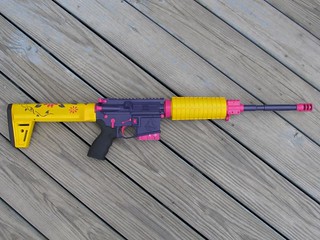
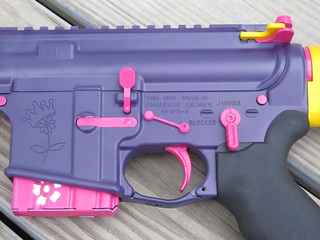
ZerCool things he's all badass, but he built this AR for his wife.
It's called the Delicate Flower. This is the rifle a pony would use.

The beauty of the AR platform is its inherent flexibility. It's been called "Legos for grownups" and "Barbies for men" and neither one is a bad comparison. (Editor's note:  I have been informed that it is impossible to spell "Barbie" without "AR".) The rifle separates into two halves (conveniently called "upper" and "lower") by pushing out two pins. Very few special tools are needed to do depot-level maintenance or assembly on an AR, and even fewer for assembling the lower - the actual "firearm".

This is a stripped lower receiver; the only piece of an AR that requires an FFL be involved.

DSCN0932


There are plenty of quality manufacturers out there and a few not-so-good. The bottom line to look for is a forged, mil-spec receiver. (Cast receivers exist and have a higher potential for flaws; avoid them.) York Arms is a personal favorite, because of options for custom serial numbers and markings - but you'll pay a slight premium for that level of service. Expect to spend $100-150 for a lower. (There are other options out there known as "billet" lowers which are twice as expensive and provide some other options - prettier lines, colored anodizing, etc. A good example is Seekins Precision.)

Once you've got a lower in hand, you need a Lower Parts Kit (LPK). This contains all the springs, pins, catches, and so forth needed to transform the paperweight of a stripped lower into a "complete" lower. LPKs are generally about $60 and will included a generic trigger and hard plastic A2 pistol grip. Assembling the parts kit requires a pair of pliers, a gunsmithing hammer (I have a Shooboy Hammer, which can be ordered from the user of the same name over at the S&W Forum. It's worth every penny.), a screwdriver, a bit of masking tape, and ideally a set of pin punches. I use the Lower Assembly Guide on AR15.com every single time - I just don't build enough lowers to not need the instructions anymore. Have a clean work space with good light. Give yourself some time, work carefully, and in an hour or two, you should have a complete lower (less the buttstock).

The trigger included with the parts kit, unfortunately, tends to - for lack of a better term - suck. Grit, creep, overtravel, heavy - you name it, there's a stock trigger that has some or all of those characteristics. There are plenty of aftermarket upgrades from companies like Rock River Arms, Timney, Geissele, Chip McCormick, and on and on. Try the stock trigger before you jump on one of those; you may find what you have is acceptable for your use.

Now comes the fun part: deciding what you want to do with the rifle. Hunting? Home defense? Plinking? Precision? Big game? Each of those is a new upper and two pins away. An upper can be had found in every caliber from .17 HMR to .50 Beowulf, although the most common chambering is 5.56x45/.223 Rem.

Defending your home? Consider something in 5.56 or 300 BLK. Hunting predators? .204 Ruger or 5.56. Big game? 300 BLK, 6.8 SPC, .458 SOCOM, .450 Bushmaster, or .50 Beowulf may all prove to be good options. Plinking or fun at the range? .22LR or 5.56 are perfect.

Add the stock and buffer of your choice, some kind of sights... and you're off to the races.


Yeah, I didn't follow all of that, either. But look at this pretty rifle! It even has a cutie mark!

Monday, December 10, 2012

Monday Gunday Guest Post: A .45 for 45 years

This guest post is by Rob Reed. Rob is an firearms instructor, gun geek, gamer, and fan. You can find more of his writing at his Michigan Firearms Examiner column.

Image from Indy Gear


I was a teenager when Raiders of the Lost Ark was originally released. From the first moment I was caught up, and Indiana Jones quickly became one of my favorite fictional heroes alongside Capt. Kirk, Han Solo and Luke Skywalker. I mention that because it plays into what comes next.

I turned 45 earlier this year and thought the best way to commemorate the milestone was to buy a 45 caliber handgun. I already had a couple 1911’s so instead I picked the United States Revolver, Caliber 45, M1917, also known as the Smith & Wesson Model 1917.


The S&W M1917 was developed during World War I when the U.S. Army desperately needed handguns and 1911 (no “A1” yet) production could not keep up with demand. Instead of trying to add another 1911 manufacturer, the government instead asked S&W (and later Colt) to modify an existing revolver design to fire the standard .45 ACP cartridge as used by the 1911. This would provide the needed handguns while avoiding the logistical problems of adding a new handgun caliber.

(Editor's Note:  See this previous Monday Gunday post for an explanation of the differences between .45 Colt and .45 ACP.)

Smith & Wesson took their Hand Ejector, Second Model (HE 2), rechambered it to .45 ACP, cut down the cylinder a bit and, in a stroke of brilliance, invented the sheet steel “half-moon clip” to allow the rimless .45 ACP rounds to load and headspace correctly. Each half-moon clip held three rounds and tossing in two clips to load the cylinder was much quicker than loading cartridges one at a time.


Even though I collect military firearms, and the M1917 has a distinguished military association, that wasn't why I picked it as my birthday gun. The real reason is much simpler: The HE2/Model 1917 is Indiana Jones’ gun: This is the gun he tossed in a suitcase while talking about what a “cautious guy” he was, this is the gun he used to save Marion as her bar burned around her, and this is the gun he used to show why you shouldn’t bring a sword to a gunfight in the movie’s funniest scene. The big S&W is as an iconic part of his character as his Fedora or leather jacket.


In “Raiders” there were actually two prop guns; one in Europe and a second in the U.S. The European gun was a HE 2 in .455 Eley, and the U.S. gun was a commercial M1917 in .45 ACP, identical to the military model except for markings. Both wore checkered commercial style grips instead of plain military grips and both had their 5’5” barrels cut down to a handier 4”. Since the movie prop is based on a real gun, and a relatively common one (as collectibles go), I’d always planned to own one someday, and my Birthday proved the impetus I needed to find one.

I found this gun through a friend. It’s a military 1917 that retains most of its original bluing. (Most were Parkerized between the wars.) Some previous owner swapped out the original smooth military grips for checkered commercial grips. Since the commercial grips are correct for Indy’s gun, this is actually a plus for me.

I had planned to cut the barrel down to 4” to more closely match the movie prop, but I decided the gun is too nice to mess with the originality that much. No one but a die-hard fan will know the difference anyway.

I’ve had the gun at the range a couple times. The first time I was dropping steel plates, six for six, at about 12 yards with no problem. On the second trip I was able to shoot at paper at 25 yards and discovered that, even with the small sights, the gun is a shooter. I could consistently keep all my shots pretty well centered on a paper plate shooting both single-action and double-action. Not bad for a 92 year old gun and 45 year old eyes.


This Indy gun (sort of) replica now goes with my Indy jacket replica into that weird area where my fandom and real world collide. I may not be Indiana Jones, but I’ve got his gun!

Monday, October 1, 2012

Monday Gunday Guest Post: Carrying the PMR-30 Concealed

Today's guest post comes to us courtesy of Gwen Patton. In addition to being a web cartoonist, she has been an informal (not NRA certified) firearms instructor for the Pink Pistols for 10 years.

She also suffered a spinal injury in 2007, which required surgery. She needs a cane to walk, suffers from near-constant severe nerve pain, and cannot withstand the recoil traditional self-defense calibers ("32 acp, you might as well throw the gun. 380, you might as well shoot 9mm," she said in an interview). However, she has found the Kel-Tec PMR-30 to be an effective concealed carry pistol that is comfortable for her to shoot.

This is her story.


Lightweight and Low-Recoil: 
Carrying the Kel-Tec PMR-30 Concealed 
by Gwendolyn S. Patton

I rested my cane up against the wall of the range lane, put down the small stack of paper targets, and hung the cardboard backer on the metal hooks thoughtfully provided. The roll of masking tape was on a chain attached to the shelf, and I tore a piece into three little tags to attach a silhouette target to the backer, two at the top, one at the bottom middle to keep it from blowing around in the slight breeze of the exhaust fans. I used the electrical lever to run the target out to a decent 10 yards, good enough for a half-size target, and a nice warm-up. I had three boxes of ammo, one of hollowpoint carry ammo, two of target ammo. I like to practice with both, so I don't get disused to the feel of firing what I carry.

My bag was still slung across my shoulder, and I reached into it to draw out the weapon, which I placed safely on the shelf, pointing downrange. Likewise, the second magazine which was in a side pocket. I’m not a big fan of off-body carry, but this is a new weapon, and I haven’t yet found a good concealment holster for the dead of summer. If it was fall or winter, I could use my shoulder rig and a jacket, or my 511 conceal-carry vest, but it’s over 90 degrees out there today, t-shirt weather, and it’s hard to conceal anything, much less something full-sized. So into the bag it goes. The upside: it doesn't weigh very much, even fully loaded, and doesn't drag on my shoulder even as much as the sketchbook and pencil box it replaced.

The weapon is my brand-new Kel-Tec PMR-30, a sleek steel and aluminum device with a Zytel grip, magazine, and trigger guard. Unloaded, it weighs only 13.6 ounces, and a full 30-round magazine of .22 WMR weighs 6 ounces. With a full magazine and a full spare, it comes in at just under a pound. Yes, I said a 30-round magazine. It’s a double-stack polymer magazine that, admittedly, is slow and difficult to load, but once you have it loaded, represents a significant throw weight of defensive fire. The 4.3” barrel is the shortest Kel-Tec felt sufficient for reasonable accuracy, and I agree. I have an old Charter Arms .22 WMR revolver with a shorter barrel, and it’s one of the most inaccurate firearms I've ever fired. But the Kel-Tec is a tackdriver.

I take my stance on the firing line and rack the slide. The slide throw is not long, and the slide isn’t heavy. There’s a slide-release lever on the left side, convenient to the right thumb, and an ambidextrous safety above and behind it. The sights are high-viz fiberoptic dots, very bright and clear in just about any light, but are of little or no help in total darkness. There is a short Picatinny-style rail under the barrel that will accommodate a light or laser if you wish.

The trigger is smooth and does not suffer from excessive grab, stutter, or steps. It releases cleanly with a firm squeeze, and here is where the nitpicks begin.

All Kel-Tecs have an issue with grip, from the P-11 upward. You cannot limp-wrist a Kel-Tec,or it will not cycle properly. The same is true of the PMR-30. You must have a firm grip to provide a solid foundation for cycling the action. Failing to do so will usually result in either a stovepipe or nosing on the ramp. There is, however, a caveat to that. The factory expresses a keyholing issue with 40gr Maxi-Mag ammo, and claims it will feed properly otherwise save for sporadic keyholing, but I have found it to be somewhat more comprehensive than simple keyholing. I found out that if you use this particular ammunition, you will suffer interminable nosing on the ramp every 3rd or 4th round, regardless of grip, while the 30 or 50 gr. rounds will function perfectly unless you severely limp-wrist the weapon. The company strongly recommends against foreign ammunition, that may not follow strict standards of case pressure, and I did not tempt fate.

I found that the 45-gr hollowpoint Federal ammo I am using for carry works quite well, does not tend to nose on the ramp, and is highly accurate, though I did find at first that the sights tended to pull to the left. It took a couple of magazines to find that I had to place the post on the right hand side of the notch consistently to achieve perfect accuracy, but once I did this, I could put rounds down the same hole with significant frequency, thus earning the “tackdriver” classification. This was at ranges of between 7 and 15 yards on an indoor range, with half-size silhouette targets, simulating defensive distances.

The weight of the weapon during use was minimal, as was felt recoil. This resulted in quick target reacquisition and a shortened time to second shot. With a small, light round, this is essential. But why did I choose such a small, light round in the first place? Why not use something heavier, with more stopping power? Actually, my old choice of weapon was my Kimber Pro-Carry Ten II, a 14-round .45 ACP, or, if space was a premium, a S&W 649 Bodyguard .357 magnum. But a few years ago, I had a car accident and broke my neck.

Complications from the neck repairs left me in constant pain, and unable to practice with a larger weapon, because the recoil up the arm and into the neck leaves me in acute distress. I might be able to use a large-caliber weapon in an emergency, but I can't sustain long practice with one. I can, however, practice with the PMR-30, and the large magazine capacity means it is even viable for self-defense if necessary. I haven’t gone shooting for years until I got the PMR-30 because of excessive pain. Since I got it, I've gone shooting three times, and gotten my skill back easily.

I do believe the .22 WMR is a viable self-defense round, and here’s why: the FN FiveSeven is used as a military sidearm in several nations, and the FN P90 PDW is used by Special Forces and Counter-Terrorist groups. The FiveSeven fires the NATO 5.7x28mm round, with a bullet weight of between 23-31 grains and a muzzle velocity of around 2,000 f/s, giving a kinetic energy of around 400 ft-lbf. The .22WMR has a bullet weight of between 30-50 grains, a muzzle velocity of 1,200 f/s from the PMR-30, and a kinetic energy of about ¾ that of the NATO round due to the greater mass of the bullet. When fired from a rifle, the kinetic energy of the .22 WMR round is nearly the same as that of the FN FiveSeven’s NATO round, and the PMR-30 has 30 rounds to the FiveSeven’s 20.

Beyond that, I’m a firm believer in shot placement as the key to stopping power, and the accuracy of this weapon is fully up to the task. The only thing I need to find now is a good dedicated on-body concealment holster that works in hot weather as well as cold, designed specifically for the PMR-30. I have found one online from Simply Rugged Holsters, but have not yet acquired one for testing. Being a high-quality leather holster, the cost has been prohibitive right now, but I plan to get one as soon as I can. The holster I have my eye on can be worn outside the pants, or with special straps inside the pants for full concealment. I would really like to try this, in hot weather it sounds like it would be exactly what is called for, when just a t-shirt would cover it.

Until then, I’ve been making do with off-body carry, which works decently due to the low weight and bulk of the weapon, or with a generic standard 1911 strong-side holster that my father’s old Remington-UMC 1911 was stored in. I borrowed the holster and left the 1911 in the vault where it will be safe (no pun intended), and the holster works fine so long as I have a jacket or long button-down shirt to cover it. The weapon is so lightweight that I scarcely feel it on my belt, and all of the length is in the barrel, do I don’t get a beavertail poking me in the kidney like I do with a 1911. I’ve worn it all day like this without significant discomfort.

In conclusion, for $400 -- about a third the cost of the FN FiveSeven, firing ammo that costs far less than the FiveSeven's -- you get a weapon that’s lighter than a FiveSeven, holds more ammo than a FiveSeven, and has nearly the punch of a FiveSeven. It isn't without some issues, and probably could benefit from a “fluff and buff”, polishing the ramp and other moving parts to help avoid feed and extraction issues, is a little finicky about ammunition, and could stand to have the sights slightly tweaked. But it’s not finickier than some 1911’s, and overall, it’s an acceptable piece of hardware that carries easily, and with some practice can be accommodated and used effectively.


The following are some follow-up questions I asked Gwen based upon what she had written:

You say you are, or have been, a firearms instructor?
Not NRA Certified. But I taught informally for about 10 years in the Pink Pistols. I founded the Delaware Valley Chapter, and was the organization's International Media Spokesperson from about 2004-2011. I stopped teaching regularly in 2007, when I had my spinal surgery, but still gave advice from time to time, and have been politically active in support of the 2nd Amendment for a long time.

How long have you been carrying your PMR-30?
I've had the PMR for about a month, I'd say. Except for the time when I've been out of state, I've carried it.  I'd wanted one for a while, but I had a terrible time finding one, and when one became available, I jumped on it.

How many magazines do you carry every day?
I typically carry one spare magazine if I have it.

Do you have any accessories or modifications on your PMR-30?
Except for the generic holster, no. I haven't had it long enough to figure out what I'd want, or what would be useful. I think I might have it "fluffed and buffed", perhaps the ramp polished and some of the sharp edges dehorned, and the sights trued, but other than that, I don't know I will add anything. I don't know that I'll use the rail right now.

If you could tell Kel-Tec anything, or have them fix anything, what would it be?
Three things: Make the magazine easier to load or include a loader, make the sights more easily adjustable, and address the ramp-nosing issue. If a Lula loader becomes available for it, I'm getting one.

What kind of issues are you experiencing with the magazines?
I've got very sore hands because of nerve problems, and it just takes a long time to load them. If you follow the book and put the rounds in slowly and pack them like they say, it works fine, but it takes forever.

If you don't mind my asking, what kind of accident did you have? 
After work one evening, I was re-arming from the safe in my trunk, and a 40 mph wind blew the steel trunk lid down on my head, compacting 3 vertebrae and effectively breaking my neck. I had surgery to fuse the 3 levels and put in a titanium plate, but complications caused bone spurring at each of the levels.

What are your injuries?
As a result, I have severe nerve pain throughout most of my body to one degree or another all the time. I can walk short distances with a cane, but beyond the distances inside my house, I need the powered wheelchair out in my van. It simply hurts too much and tires me out too much to go further on foot.


Gwen's webcomic, Jenny Everywhere's Infinite: Quark Time, may be found here.


Tuesday, April 24, 2012

Monday Gunday*: the Chiappa Rhino

*special "late because of guest author Jeff W." edition

Howdy y’all, I’m Jeff and I’m back for another guest spot for Erin’s blog. A while back I wrote about my experience with firing a Mosin-Nagant for the first time, and I have a new gun to talk about today: the Chiappa Rhino 40DS (4” bbl).


I wanted to write this review for a few reasons:
  1. The Rhino is still pretty thin on the ground so I figure anyone looking for one would be interested in another review on them.
  2. Most of the existing reviews are very one sided, either pro or con.
  3. Most of the reviews I've found were for the 20DS (2”bbl).

I first became aware of the Chiappa Rhino after seeing a picture of it on a gun forum, and I really fell in love with its style (or arguably, its lack thereof). I wasn’t familiar with the concept of a low bore axis revolver and I think that’s another thing that really endeared the Rhino to me. Almost immediately after seeing the pictures of this gun I decided I wanted to track one down, and that’s when I came to discover that they’re thin on the ground. Not one gun store in the Oklahoma City metro area had one for me to come see, let alone handle or shoot. I expanded my search to Tulsa and Stillwater and even Lawton (about a 2.5 hour drive), and I couldn’t find one anywhere. So I thought about ordering one online.

Now here’s the thing: I’m generally against this. I want to see/handle/shoot a gun before I buy one. The only exception I’d ever made for this was the aforementioned Mosin, and that was only because it was so cheap; if I hated it I was only out ~$100 and I’ve wasted more on less. But as they weren’t to be had locally for love or money, if I wanted one online was how it was going to have to happen.

As I couldn’t form my own opinions on the gun, I did the next best thing and went to the oracle of our age, Google, and found online reviews, and what I found were either hosannas or damnations, with very little middle ground. People loved the 2”, shooting it in .357 was easy, .38 was easier; or people hated it, the mechanism was overly complex and prone to breakage, and the whole thing was overpriced. One particular horror story about the 40DS breaking and taking 6 weeks to fix through Chiappa customer service was almost enough to put me off the endeavor entirely. All this made me realize how divided the gun community is on certain things that I consider to be pretty minor. Was this something I really wanted to get myself into? I waffled on the decision for a while but when my tax refund came in I decided to just go for it.

I ended up with the 40DS in .357 with the blued barrel. I wanted the stainless version but it was about $100 more and I just didn’t want to pay that much. I found my gun on Gunbroker.com, a site I’d been familiar with but never used before. The seller I found had a very high rating (Gunbroker is basically the eBay of firearms) and the transaction went very smoothly. I had already contacted a shop to handle the FFL transfer, and they’d dealt with Gunbroker before, so they were very helpful. I won my auction on Monday morning, and by Thursday afternoon I had my revolver. I was pretty excited about it.

Let’s talk about these guns for just a moment. They’re milled out of ergal (a type of aluminum alloy commonly used in airplanes) with steel barrels, cylinders and inner workings. When I say inner workings I’m referring to the things that people were complaining about being overly complex; the words "Italian race car" and "Swiss watch" come up when discussing this gun.


And there’s a reason for this concern. These guns are by design and nature very complex. Think about it for a moment: with a low axis barrel, the hammer isn’t in the position that the hammer normally is in on a revolver. If it was, it wouldn’t strike the correct chamber. Instead the hammer is internal. Actually,  it has two internal hammers: one for single action, one for double action.

That spur on the top? Yeah, that’s not the hammer, it’s the “cocking lever.” The Rhino was the final design of Italian gunsmith Emilio Ghisoni (of Mateba Autorevolver infamy) and like darn near everything designed by Italians, over-engineered isn’t the right word, but it's close. "Complex" isn’t far off the mark either.

My Rhino has a 4 inch barrel in .357, with a wood grip and fiber-optic front sight and adjustable rear sights. I guess they offer it with a rubber grip and I’ve heard decent things about that, but I believe that a full sized revolver should have a wooden grip. It’s quite strange-looking, beaver-tailed and thicker at the top. It is connected to the frame of the gun with a hex-nut at the bottom. 


I think this is sort of a neat design. Everyone who got a look at this gun really liked the design (even if they said things like “chunky” or “blocky”), and agreed that this grip was very comfortable. Even my friend J, who has fairly large hands, felt that the gun was comfortable; he had been worried that the grip was going to be a little small for him.

Another neat design element is that the cylinder is actually hexagonal, not round. This means that when you’re carrying the gun it always has a flat surface in contact with your body, which ostensibly makes it slimmer and easier to conceal. While I don’t know about that, I do know it looks cool. The cylinder rotates clockwise instead of the more common counterclockwise. I haven’t discovered a reason behind that yet, but it’s interesting in that it’s yet another nonstandard design element in an already unconventional gun.

But enough about the gun itself. Let’s get to the meat of this: my thoughts on shooting the Rhino.

I haven’t had an opportunity to really put it through the paces I prefer when breaking in a new gun, but I’ve put ~250 rounds through it, both .357 and .38 caliber, with the majority of those being .357, including full house 158 grain japes. I’d like to get another 250 through it because I think that if you’re going to have problems mechanically, they will probably surface within the first 500 rounds. I’m hoping to get the other 250 through in the next couple weeks. However, after 250 rounds I didn’t have a single misfire or failure to fire. I’d heard of this occurring, with the hammer not striking the primer hard enough, but this never happened to any of us out there at the range.

Recoil on this gun is minimal to the point of absurdity. The low bore axis really reduces muzzle flip by having the recoil go straight back into your hand and wrist (instead of at an upward angle), and while it sounds uncomfortable, it's actually very manageable. This also has the advantage of keeping your barrel more in line with your previous shot.


Please note this isn’t my hand. This is just a picture for illustrative purposes.


All of this means that firing full house .357 rounds feels like shooting .38 rounds from a similarly-sized revolver, and .38 rounds are like shooting a .22 (or as J said, "Like shooting BB's"). I fired 158 grain JHPs from this and then from a S&W Model 29, and I could really feel the difference in recoil even in the two very differently-weighted guns.

The things I really like about this gun are ergonomics,design, and lack of recoil. Now let’s talk about something I am sort of indifferent about (the trigger), and then the two things I really don’t like (the cocking lever and the sight picture).

Trigger pull on this gun is very odd. The double action pull is very smooth, but it is long and heavy.  I don’t have any sort of accurate gauge (not owning the equipment), but I’d bet it’s in the 12-14 pound range. The single action pull, by contrast, is incredibly light (probably around 4 pounds) and very, very short.

The two things I don’t care for are the cocking lever and the sight picture (though I expect to get this worked out shortly). The cocking lever (that spur on the top) is used to get the gun into single-action (SA) mode, and it is enormously hard to pull. I can do it with one thumb, but I have to pull the gun WAY off line to do it. I don’t see myself using SA that often, so I’m not terribly worried about it, but it’s crazy heavy.


As for the sight picture, I’m used to image 3 but the Rhino shoots closer to image 1. There were 5 shooters putting the Rhino through its paces, and all of us had difficulties mastering the sight picture on this gun. I’m confident that more time on the range will iron this difficulty out, but currently I am less than happy with the Rhino's sight picture (but again, I’m 99% sure this is user-induced error and will get worked out).

Overall, I’m pretty pleased with the Rhino. It’s a pleasure to shoot, it’s got a unique look (although less unique now due to the Total Recall reboot trailer**), and if nothing else, it's a pretty good conversation piece. More than one guy at the range made noises about being able to see a Rhino in his future.

Would I use it as an every-day carry (EDC) gun? I don’t know. Certainly not until I’m used to the sight picture, and holsters for these guns are harder to come by than the guns themselves (except for the 20DS, which ships with a pancake holster). But if I could get a decent holster after I become more comfortable with the sight picture? Maybe. Will I take it to the range and blow stuff up with it? Every chance I get.


** Editor's Note: It should be noted that Jeff is a gun hipster.

Thursday, November 24, 2011

Broken River: A Thanksgiving Interlude

Broken River
Interlude: Little Big Chicken Ranch
by Mike (Rhishisikk) Kochis


Background
For those following the Pellatarum threads, this is something that Erin picked up a while ago, played with, and then got all distracted by life. But, as she pointed out to me, it fits really well with what's going on in Broken River.

Little Big Chicken Ranch
Not all things a town is famous for are in the town proper. Some, like the Little Big Chicken Ranch, are on the outskirts, the farmsteads that make "civilized life" possible.

In a nutshell, the LBCR raises dire chickens, because they have the fortitude to survive the elemental mish-mash that constitutes yearly weather, enough mean on them to resist predators, enough meat to make it worth all the extra hassle, and are still able to be handled by normal humans.
To date, attempts to mimic the success of LBCR have met with failure, and usually needed adventurers to remove the rampaging territorial chickens.


The NPCs
Garvin Olvewaithe (commoner 5) is the farmer known for running the Little Big Chicken ranch, but much of the actual work of the ranch and the homestead itself is done by his wife, Marta (com 6, our most experienced commoner). He also employs a half dozen "caretakers", who rapidly rise to second or third level (or end up being torn apart by the foul-tempered fowl).

Their oldest child is only seven, but has already gained second level. Mimi Olvewaithe is terrified of the "clucking horrors", and swears up and down that she's going to do something sane with her life. In spite of this, she hauls feed, pesters the ranch hands, and generally gets underfoot the way in which only a seven year old can manage (and only a seven year old is still cute enough to get away with).


The Tenants
For stats on dire chickens, see Erin's article here.

There are two conflicting natures – the dire beast and the chicken. Marta discovered that the chickens take shelter when she bangs two metal pots together. However, the chickens are smart enough to recognize wielded weapons, and will swarm fearlessly to defense of "their" territory.

Unlike most dire beasts, the chickens have been raised together, and work as a pack or swarm rather than individual beasts. They have learned not to attack their fence of woven barbed wire, but every so often, one (or more) will flutter into the air and find themselves landing on the outside of their pen.

Like all dire beasts, they breed like a plague – if they weren't being constantly harvested for their meat and eggs, they would have already taken over the entire farm and destroy the surrounding landscape. There used to be a detachment of four soldiers from the town guard, until times got so desperate that they were needed elsewhere (but the watchtower remains at the crossroads between the four pens.


Layout
As noted above, there are four pens. These are connected by buried walkways, allowing the chickens a single "territory". Each pen includes an artificial "cave"*, where the females can lay eggs and the entire flock will retreat to if exposed to fire, loud noises, rainy weather, arrow fire, or other situations which just cannot be resolved by swarming and pecking (the default reaction of the chickens).

The fences of the enclosures are wood covered with barbed wire. Collectively, the chickens are capable of destorying the fences – but they've never been worked into enough of a frenzy to discover this. Generally speaking, only the lower-status members of the flock spend a lot of time near the fences.

At the crossroads between the four pens are a watchtower and several "feeding troughs", which rely on gravity to get the feed past the fence. Two spears (to fend off hungry dire chickens) are also in this area. Again, the owners and hands make very certain to keep the flock well placated.


Town Politics
The Olvewaithes are not much liked by their neighbors, who are convinced that they are raising monsters. In spite of over a decade of prosperity, they will never be trusted to control their animals. This means their feed prices (from their neighbors, at least) are higher; part of this is grudge, the rest is greed (the ranch is relatively lucrative).

This means that most of the feed is actually bought from Thornshire, Broken River's halfling community. When relations are strained, and the halflings stop exporting, this includes to the Little Big Chicken Ranch. The residents of Thornshire are all to well aware of the pressure this puts on the entire northwestern farmland, and the town in general.

Although being on the "safe" side of the river, the LBCR is a target by the nearby orc tribe. For their part, the Olvewaithes are indifferent to the "orc tax" and to picking up the occasional dead orc body out of the pens – it's just one of the normal hazards of business for them.

Druids, generally speaking, hate the LBCR for "caging" dire animals (and more than one druid has died attempting to set them free).

Every so often the Smuggler's Union will attempt to "export" one or more dire chickens to another farm; these efforts always end badly, and the Olvewaithes have stopped selling their chickens, to include fertile eggs. Not that this stops the attempts, but that's between them and the flock.


Adventure Seeds
Seriously? If you can't already see three potential plot devices, go – no, no, not going there. I apologize.
  • Escaped chickens are a fact of life at Little Big Chicken Ranch. Normally there are just one or two, pawing around the outside of the fences, and wondering how they got outside. But as your player's level increases, it may be necessary to cull the entire farm. (The exact number of dire chickens on the ranch at any given time is deliberately left vague.)
  • Mimi is just the cutest little budding adventurer ever. She also knows that she's small enough to fit in a backpack. This is a dangerous combination.
  • Dire chickens eat a LOT. This means convoys of feed (both grain and meat) crossing the farmlands, year round. This means weather, banditry, and wandering monsters.
  • The neighbors have a dichotomy of their own – they don't want those monsters near their farm, but they're also afraid that if they try to do anything, ALL the chickens will escape at once.
  • Every few years, some idiot gets it into their head that dire chickens are just bigger chickens. Surely they would make good pets, or could be trained as circus animals. Meaner than normal chickens, you say? Perhaps guardian beasts...
  • As with any industry that makes money, LBCR attracts its share of bandits and robbers. The signs "Trespassers will be fed to the livestock" do little to deter such individuals.
  • If you're attempting to cozy up to the local orc tribes, they routinely lose braves who choose to steal a dire chicken from LBCR as one of their combat trials. A more difficult trial is capturing one alive.

Happy Thanksgiving, everyone!


 * I asked Mike what he meant by "cave" and he clarified it as "a chicken coop covered with dirt on three sides and on the roof."  While this makes sense, I am rather fond of the notion of it being an actual dugout, wherein intrepid farmhands must venture into the warrens, like a tunnel rat, to retrieve eggs or die in the attempt...

Friday, November 4, 2011

Pellatarrum: Broken River 5

(Editor's note: the lateness of the Broken River series is entirely my fault. I was sick for a large chunk of October, and had little desire to proofread Mike's articles... or do much of anything, really. )

Broken River
Part 5: Kobold House
by Mike (Rhishisikk) Kochis


Purpose
In this article, we start weaving the disparate threads together, in the form of Kobold House. As mentioned, each nonhuman race has a maximum of a dozen members. Eight of the kobolds in Broken River live in Kobold House; the kobold outcast (yes, kobolds have outcasts too) resides at the Grey Shovel, a boarding house/tavern on the "dirty side" of town. But let's cover Kobold House first.


Kobold House
It is no secret that kobolds are the most loyal, most devoted, and most obvious servants of the dragons. Part of the kobold reputation as devious, backstabbing, trap-making, child-stealing, poison-using murderers comes from this devotion, so that when kobolds are seen, most folk see only their masters. Dragons, who are known for sometimes eating their foes, are feared and not well-liked.  The rest comes from them being murderous, backstabbing, devious trap-makers who steal children and like using poison.

One hundred and twenty years ago (several generations), there was a pogrom against the two kobold tribes of the town. It may have had something to do with a stable burning down where the two tribes squared off against each other and some visiting goblins. Or the fact that one of their chieftains had (allegedly) taken to wearing the skins of townsfolk. Or that the other had (reputedly) eaten a gnomish child alive. Whatever the reason, the commoners decided to have two words with the kobolds: lynch mob.

Their numbers depleted by back-alley fights, poisonings, and other shenanigans to which rival kobold tribes are prone, and with both chieftains dead or dying, the remaining kobolds did the unthinkable: they trusted their enemies. The remnants of the rival tribes agreed to put their feud on hold until the troubles passed, and took shelter under the floorboards of an abandoned building. 

That alliance remains to this day. The kobolds were hopelessly cross-bred within the first generation, and every member of the current tribe professes to serve both dragons (neither of whom actually reside within Broken River). Although Kobold House has the resources to support double the number of adults, the number of secret allegiances, mistaken poisoning of allies, deliberate poisoning of enemies, attacks by their children (who rightly think they are abused), and the other uncertainties of life keep their actual numbers where they are. This confusion is compounded by their current chief, whose name in Common is rendered as Summoner-of-the-Greatest-of-Dragons (yes, he's our level 2 summoner). Please observe how there is no qualifier given as to which dragon is actually the greatest; this is deliberate. 

The inhabitants of Kobold House serve both the Brilliant Dragon and the Shadow Dragon (see below) in that they ostensibly follow the will of and advance the agendas of their twin masters. However, the Dark has a greater hold on these kobolds than the Light, as the politics of Kobold House is a tortuous, labyrinthine thing of deception, double bluffs, and triple agents. The kobolds are so wrapped up in pretending to serve and yet not serve both dragons that it is likely they themselves either don't know, don't care, or are actually insane (even by kobold standards). Their chieftain actually is insane with a complex form of Air Disorder: he has at least two personalities, each of which fervently believes it loyally serves only one master and feigning obedience while plotting the overthrow of the other. 

One kobold,  a level 1 expert known only to townsfolk as "Grippi," lives well away from Kobold House and has decreed that he will not knowingly serve either dragon. As a consequence, he is generally unemployed and otherwise miserable, but at least he's sane.


Why Grippi?
Grippi the Outcast has been a popular NPC in most of my campaigns. The out of work "monster", hated by even his own people, pulls at the heart strings, and Grippi has made a wonderful henchman and accomplice for several players. When I knew that the kobolds of Broken River were just insane, I knew that Grippi, the last sane NPC kobold in Broken River, had to be in attendance.

He provides the "half rogue" that many parties need to pick locks and disarm traps, without being so awesome that he overshadows the PCs. His natural humility, knowledge that nobody else is showing him kindness, and kobold tendancy to worship his "boss" also plays to the PCs as the center of the action. And he's willing to work on the cheap...


The Dark Dragon
When people in Broken River complain about "the dragon", they're complaining about Doomwing Dark-Drake, the black (acid) dragon who lives somewhere in the river delta. Although he's known to have ties to piracy, he doesn't permit it to affect "his" infestation of humans. Also, he is still bound by ancient contracts with the halflings and sea elves to keep the river clear of pirates between Broken River and the sea.


Doomwing won his contest with his rival for this territory by a daring (reckless) mid-air collision, followed by a plunge into a swamp lake (rumored to be his main lair) and a near-drowning. Recently, he has stopped recruiting kobolds (although he still keeps a few hundred around) in favor of a once-small tribe of lizard men. The "dragon tax" they collect at night has become obnoxious to the sheep farmers of Broken River's southern regions.

Doomwing is an avid collector of pottery, fine china, and flatware. His crowning treasure is a teapot of huge size, enchanted to heat its own water. Visitors normally contact him through the lizard men, and he meets with them in the main square of their village deep within the swamp.

Nobody knows (beyond piracy and smuggling) what Doomwing's ploys are, which leads locals to associate him with the Temple of the Dark.


The Brilliant Dragon
Songmoon River-Dance, commonly called the Brilliant Dragon by kobolds, is a green (sonic) dragon not local to Broken River. She lives far, far to the northeast, on the other side of the Orclands (local orc lands, not the global region, which is much larger and a nation in its own right). Her interest is in Imperial (regional human) affairs, of which Broken River is only a small part. Before Bracken River became Broken River, it was of no interest to her; whether she employs, supports, or opposes Seamus Gantry (7th level commoner, imperial clerk) is unknown at this time.

She moved into her territory when her mentor died due to a few (hundred) fussy humans, who only complained about how many of them he was eating for a few years before gathering in an army, besieging him in his lair, and killing him. After the usual squabbles with other contenders (none of whom died), she has stepped into his shoes gracefully, and added his ploys to her own.

Songmoon owns a number of palaces, but is partial to one maintained by an outcast clan of dwarves. She is far too busy to bother directly with Broken River (for now), but has sent a number of agents to actively recruit. As trade between Broken River and the Sea Elves increases in importance to the Imperium, so will Songmoon's interest in "local" affairs.

Songmoon used to collect music, a passion that she continues by habit more than interest. Her new obsession is that of her former mentor: collecting blackmailed and bribed Imperial officials. Whether she has footholds in Broken River's corrupt government (which we'll get to in a later article) is up to the GM.

Songmoon is a passionate supporter of the Church of Light. Rumors that she is sponsor of the heretical Children of the Sun are lies. Scandalous, scandalous lies, spread by her detractors. You know because Songmoon River-Dance says so. No dragon would ever lie to you, right?


PC Kobolds
I know what you're asking. Why would a PC kobold want to live at Kobold House? 

They shouldn't. Kobolds, by design, should feel out of place in Broken River. They should make perception checks to notice that crazy cat lady is signaling them. The watch keeps tabs on them, and follows them in that way humans call discreet. And those that do want to live with crazy, deceptive, lying poisoners and trap-makers? Let them - they're playing KOBOLDS!


Class Training
Obviously, Summoner himself can train summoners, although both (or all) of his personalities will feel challenged by an acolyte who summons a draconic-looking eidolon.

Although none of the kobolds possess rogue levels, even Grippi the Outcast has enough experience in Craft (Traps) to train rogues and/or rangers. Many kobolds also possess ranks in Sneak, Survival, Craft (Poison), Sleight of Hand, and other skills of dubious morality.

I had originally thought of giving one of the kobolds levels in alchemist, but honestly – it has more reason to be elsewhere, so it is. This isn't to say that Kobold House doesn't have a modest store of alchemical fire (and other alchemical nastiness), for it does. But none of them have the actual alchemist class.


Why No Rogues?
I was really pressed to put three other classes into Kobold House: rogues, experts, and alchemists, in that order of priority. And nothing prevents you from doing so, if you feel it aids the feel of the town for your players. But summoners are rare, and the best summoner in town is a kobold.

The kobolds are quite able to provide for all things koboldish without tapping any of these classes – so I didn't. This isn't just so that Summoner shines; this is so the PCs have a chance to shine. That, and realizing the alchemist would spend most of his time in a straightjacket for the safety of Kobold House.

I'll explain. First level characters are actually fairly common in Broken River, due to the number of classes we need to cover and the fact that I believe in backups for when half the town gets burned down because both sorcerers in the party feel the need to play with fireballs while the rogue and fighter compete to see how many fireman helmets (complete with head) they can collect tonight.

But, my own bad players aside, look at the ethos of "One in a hundred becomes a successful adventurer." That means about twelve in all of Broken River. This is actually achieved at second or third level, depending whether you like rounding up or down. Since Broken River is intended as a basic starting area (levels 1-5), this fits fairly well. And second level isn't that hard to get to – provided you don't do silly things like the above contest.

But even though first level is "not that special", there is no reason to bury the rogue PC in a world of rogue NPCs. If every halfling, goblin, and kobold is a rogue, then the question rapidly becomes "Why are you, a PC,  worth a share of treasure? Hey, guys, let's just hire that rat-catcher guy for seven silver a month. I'll bet he knows how to disarm traps."

And this is just the wrong sort of question for players to be asking each other.


Options
Yes, options. I once read a Shadowrun book (stay awake, this becomes relevant) that presented options, rather than cold hard facts about places. This allowed the twin objectives of keeping the players in discovery mode (even if they had the book) and allowing the GM to customize their world. So without further ado, let's jump in.

Loyalty options:
  • The kobolds honestly attempt to serve both dragons. 
  • The kobolds are paranoid and insane, abandoned by both dragons.
  • The kobolds just try to survive, following whichever dragon their "chief" supports at the moment. 
  • Each kobold knows which dragon they serve, but doesn't trust anyone else in the tribe. 
  • The kobolds are fed up with the paranoia, and don't serve either dragon – but they can't pretend to be anything but fanatical with all these other fanatical dragon lovers around them.

Chieftan options:
  • He's insane, as written. 
  • He's playing the tribal loyalties against each other to winnow out competition for chief. 
  • He's playing tribal loyalties to ensure only the strongest survive. 
  • He hates both dragons, and is playing the tribe against itself to ensure neither dragon gets utility out of his kobolds.
  • He actually serves a third, undocumented dragon, and is trying to frustrate the tribe into leaving.
  • Optional Archetypes: If using optional class templates, Summoner is an ideal candidate for being a Synthesist (Ultimate Magic, p80). In this case, the option that he intends to become a dragon is also an option.
  • Basic Rules: Some groups just like playing with the absolute basics. In this case, replace Summoner with Sorcerer (Dragon), perhaps with the intention of making the draconic transformation.

Grippi Options: 
  • He wants to be an adventurer. 
  • He's a plant by the chieftain to test loyalty of the tribe members.
  • He wants to be a rogue. 
  • He's under secret orders from (he thinks) one or another dragon. 
  • He's snapped, and thinks he's under orders from a dragon. 
  • He's done with dragons, and paranoia, and just wants to make a living as a commoner.

Notice that none of the above option clusters are exclusive, and the indicators overlap. And absolutely nothing keeps you from replacing my "lame" options with your own. In fact, feel free to – it keeps your players guessing, and keeps the feeling of exploration/discovery alive. And that's the whole point of having options.

Tuesday, September 27, 2011

Pellatarrum: Broken River 4


Broken River
Part 4: Faction, Faction, Who's got a Faction?
by Mike (Rhishisikk) Kochis


Well, everyone has a faction, naturally. Most of us don't realize that we have more than one faction. Note that faction isn't an allegiance – it's a cause to which we contribute, whether we support it or not. And, because we normally get something back, if only a feeling of accomplishment, we normally keep tabs on what's going on with our faction.

For example, I once had a job with fast food. This doesn't mean that I'm attempting to pawn off grease burgers and convert the vegans. It means, that for a time, I was assisting a fast food place in exchange for money.

Take a look at a political faction, the Trask family. All are members of other factions (with the possible exception of Susan, but it's just because we haven't detailed her yet). Harver Trask is obviously going to be concerned with anything affecting his family, the Church of Light, and the Sow's Ear.

In other words, the conflict between Light and Dark and the Elements isn't just a matter of metamagical balance. It's something that affects and drives the lives of our NPCs.


Which Factions are Important?
Well... to whom? To your players and their characters, of course. Naturally, I don't know who your players are and what races, classes, archetypes, and whatnot they're playing. So I have to cover lots of bases. How, you ask, is such a thing possible?

Human nature, of course.


Stage One: Class
Remember how I told you not to generate the mayor? Now is when we generate the mayor, decide what branches of government are important, and start to worry about things like laws.

Also, we need to look at our "big four" classes, and set up at least two factions for each. I never set an upper limit for factions, which does come back to bite me in my buttocks.

Okay, fighters and related classes are obviously going to be interested in the town watch, the loose array of "rangers" (mostly warriors and commoners) who patrol lands around the outlying farms, caravans that are hiring guards, and other ways to employ their skills to shine in town.

Clerics are going to be interested in the Church of the Light, the order of midwives taking care of day-to-day medicine, the disenfranchised poor, and so on. And, of course, the Cult of the Dark; note that important faction doesn't mean friendly faction.

Arcane types will be looking for libraries (we didn't put one in), the alchemists of the Salt Works, the Order of Four (four sorcerers, one tied to each traditional element), and ways to acquire one of the not-yet-existing towers for their laboratories... but we'll get to that later.

Rogues and bards will care about the Smuggler's Union (and possibly the Sow's Ear), the Ladies' Floral Society (the aristocratic women who protect their menfolk from all manner of stupidity, normally started by the menfolk themselves), and possibly even the long-standing feud between local government and the remote government clerk, Seamus Gantry (7th level commoner).

We have a number of industries, or economic powers. I decide we don't (yet) have a farmer's co-op, although one rancher on the dirty side of town is trying to organize one. Obviously, the Salt Works sits astride the town's major thoroughfare, so in spite of just wanting to run their business quietly, they often find themselves embroiled in local situations. The Mucker's Union, those stalwart commoners who dig up the clay needed for so much of the local economy, is going to be a faction. And, of course each "noble" family (local nobles, not landed gentry, like the Family Trask) has its own economic interests.

Which brings us to an important note about factions and organizations: they rarely fit into just one category. Let us return to the Sow's Ear for a moment. Clearly, Captain Sowsberry cares about both his legitimate business, and his smuggling operation. But the network of links doesn't stop with just the big boss. Because of Sumi Dragonrage, we have a link to the half-orc community. Likewise, Mister Hamsteader ("just call me Alex") in the back can be a link to halfling and gnomish interests.

But let's examine a short "loop" of links to demonstrate where I'm going with this. Captain Sowsberry runs a "package delivery" (smuggling) operation. This is managed by Harver Trask. So, there is a first-link status between Harver and the Captain. In turn, the government "officially" (I haven't decided how corrupt the government is, yet) disapproves of smuggling, and asks the Church of Light (specifically Anton Trask) to expose and stop such foolishness. This means that Anton and Harver have two first-link statuses; from Anton to the Captain is, therefore, a two link status.

In real life, I have heard it said that we are only seven "steps" (a less formal relation than our links, which is why I specifically use the term links) removed from every living person on the planet. Do I take pains to make sure all my NPCs are only seven links removed? In fact, I do not; it often happens anyway.

So, why do we care about the links? Take our theoretical halfling rogue, Chubby Chesterson. Chubby wants to do roguish stuff (surprise!), and is looking for the "thieves' guild" at the Sow's Ear. Naturally, he's going to ask his fellow halfling. Working with both the Captain and Harver, it's pretty likely that he'll know; but will he give them up to a stranger? Probably not.

Here's the problem; we're trying to motivate the party into checking out a ruined monastery for the Church of Light. Our (again theoretical) monk and cleric are on board, and our sorcerer will be hooked in by other means.

When in doubt, kill as many birds with a single stone as you can. "I know some smugglers," Alex admits, "but I don't know that I can trust you yet. There's a man what snoops around here scaring our customers, by the name of Anton Trask. Maybe if you were to find something else for him to look into? I heard the Church of Light is interested in the old Iron Fist monastery; maybe you could manage to find something there, have the church send him to look at that for a week or so?" Just the sort of quid pro quo I associate with my halflings. Now, instead of spending time screaming around town that he's a burglar and needs work, Chubby should be motivated to go to the monastery with the rest of the party.

We note that there are the ruins of a monastery in the nearby foothills (an adventure location, again a later post), and move on.

Notice that three of our four hypothetical characters have adventure hooks right there at the Sow's Ear. Every faction has adventure hooks, rumors about it in the town, and resources that they can provide to PCs they like. Most of our major NPCs will have this layout also. Although we don't flesh that out until later, now is a wonderful time to start note cards of our ideas.

Yes, this is getting messy fast, even without a cat or small child to knock the stacks of notecards everywhere. It gets messier.


Stage Two: Race
Yes, we've all heard that fantasy worlds are egalitarian, and equal for all. How boring. The truth is right there in the fluff text, even for Pellatarum. Remember how much your brain protested Sumi (our buxom barmaid) being a half-orc? Didn't you have a twinge that said Alex should be a gnome, just look at what he does? (There are games like Fantasy Craft that just blend the two races right together into a single package of small-size heroism.)

How much worse would it have been if I had said that halflings ran the paladin order, or that only dwarves were inquisitors? Right, and I'm not going to. But, over and over again, I find that authors make these "intuitive leaps" and trample all else underfoot.

So let's look at races from an elemental perspective:

  • Air: Dragons and Kobolds. There is a strong enough bond here to consider them one faction. However, as with anything that near-indestructible, dragons have MASSIVE egos, and are their own worst enemies. I was going to have just a single dragon manipulating parts of Broken River from behind the scenes. However, now that I know kobolds are a playable race, we really need two or more, for that dragon-on-dragon cloak and dagger-ness. 
  • Water: Elves and Gnomes. Ooh, this one is a toughie. Aligned, but not truly one solid faction. The elves are still feuding with their underwater cousins, which gives us two factions of snotty elves trying to one-up each other. Most gnomes have already washed their hands of the feud, probably with the recent death of one of their leaders. 
  • Earth: Dwarves and Humans. I hadn't placed any mountains nearby, and there are no minerals the dwarves are really interested in. I create Copperbeard Jaegra, and decide she's head of the Dwarven Trade Consulate, assigned out here as a punishment for original thinking. I'll put a pin in that, for later. 
  • Fire: Orcs and Goblins hate each other. In fact, everyone hates orcs and by implication half-orcs. Even orcs hate each other. I decide that one of the dirty side gangs is run by a half-orc. Pathfinder goblins are amusing; I'll need to ask Erin if they're a playable race, also. 
  • Unaligned: Halflings are curious, even to themselves. Nobody knows where they fit in the cosmology, how they're here, or even remembers how they first attached themselves like lampreys to the underbelly of the other races (Yes, even the local orc tribe has halflings. More on that later.) 
Of course, these stereotypes are rich with NPCs. Halfling rogues, gnomish wizards, elven rangers, dwarven warriors – the list is endless. I know, I stopped trying after two pages of college rule paper, three columns per page. These are rich prototypes, which your players will identify immediately, and know where they stand with each one.

The temptation here is to over-use it. I had a dwarven player once flabbergasted to find that there were twelve dwarves in a township, and not one of them was a blacksmith. Just because a stereotype exists, doesn't mean you have to use it; for that matter, just because I say something exists in my game doesn't mean it exists in yours. I ran a module once where the players were looking for their half-elven ranger guide, the strongest reason I can think of to both read a book and to use your own archetypes when you want to.

It is, as I've already said, also important to break those molds. Make a halfling monk, a dwarven archer, and other silliness. Sumi Dragonrage, for example, began her concept as a half-orc bard; but she didn't need the magical abilities to do her job. Besides, bards always run in short supply in my designs. There's just too many places to plug them in at once you run out of aristocrats, another reason I stress using commoners where they can be used.

Another risk I've hinted at; don't over-use your races. There are only 1250 people in Broken River – it is worth noting if I have more than a dozen of any non-human race. This means that the bulk of my NPCs should be human, and I've broken my own rules in setting up the Sow's Ear. And that's okay, as long as I both know I'm breaking the rules, and that I keep things in check.


Sidebar: When to Break the Rules
For example, the Order of Four. I "trade back" my third level sorcerer for two second levelers; this means all of the Four are second level. It is easier to trade down than up; otherwise you have isolated high levelers with nobody even able to step into their shoes if they end up dead from say, a rampaging troll. Don't ask; I've had three seperate groups think bringing a captive troll downtown was just a wonderful idea. One of them set the troll loose deliberately, to show off the prowess of their fighter. Without even stopping long enough to replenish their spells.

The other time to break rules is when setting up villains. I have a number of factions that just don't play nice with player characters. At first and second level, it's okay to fight organizations led by a first level fighter or wizard or whatever. After third level? The same challenge is barely a speed bump, but again that's a different article.


Stage 3: People are PeopleIt's easy to just slap a class, location, and faction on an NPC and think you're done. Sadly, this lacks verisimilitude. Lacks what, you ask? Trust me, I don't use this word because it has a lot of syllables. I use it because it's the only word other than realism, and realism just doesn't fit. Verisimilitude is the sense of reality within the accepted fantasy. For example, wizards behave differently in Conan than Earthsea; each has its own accepted backdrop. A standard wizard in one setting becomes an anachronism and individual worth noting in the other setting.

For example, it's not a stretch to give the Captain a peg leg. This has verisimilitude. But we can't give him a cybernetic arm with a built-in lie detector (although this would be cool), as that totally breaks the motif. So when adding to characters, always keep in mind that some things don't fit.

Also, as with the peg leg, just because something fits doesn't mean it has to be there. Within what I'm about to tell you, use this engineering principle: "You have not reached perfection when there is nothing else to add, but rather when there is nothing left to take away."

Read the warning label? Okay, then. Let's jump in.

Every individual should be unique, should be an individual. Perhaps the Captain likes small furry bunnies (and in his soup, he does). However, these are things that rarely come up in the process of playing the game. Players will generally care that the Sow's Ear has cheap rent, a tolerant landlord, and has a not-too-unsavory reputation. Do they care that the wine cellar is made of halfling brick? Probably not, but it's important to know.

Why, you ask? Because knowing these things – that Harver Trask can't stand wearing a tie, and thus ducks every "high society" event that his family will let him, are important to related feelings. AND it's especially important when making the town's rumor matrix, especially for Light-oriented NPCs. As a paladin, Harver Trask probably openly derides the evils of the tie as a fashion mistake when asked – even (especially) at events where he simply MUST wear one.

Look! Look! We've just added a wrinkle to Harver Trask's character. He loves his family; he just can't stand formal events. Likewise, his mother just can't have him going about offending all her important guests. With just a little effort, we've added something that "feels real" about Harver, fits with what is already there, and defines his character just a little bit more for the players. Even if they never see him in silken finery, learning this about him makes him more of a "real person" to them.

And that's what crafting a base city is all about; players should love some characters, hate others with a fiery passion (and, if we do our job just right, different characters will evoke different emotions in different players), but should only feel indifferent about NPCs that don't matter to our plot, the story we're trying to tell.

So how does this relate to faction? Exactly because people join the same cause for different reasons. Maybe Jillian, a druid, joined the lumber union specifically to minimize the damage done to wild animals. Maybe Casker Thorn joined the Jar Breakers because of his late wife's interests, and just hasn't gotten around to leaving them. Some will join for power over others, or to have another field for rivalry with their enemies.

And, of course, some fifty to seventy percent of any faction's members are there just because they fit into the model of an "ideal member". Again, it depends upon the faction and the NPC.

But I'm approaching the limits of a single post, so I'll be back soon with a look at the kobolds of Broken River.

The Fine Print


This work is licensed under a Creative Commons Attribution- Noncommercial- No Derivative Works 3.0 License.

Creative Commons License


Erin Palette is a participant in the Amazon Services LLC Associates Program, an affiliate advertising program designed to provide a means for sites to earn advertising fees by advertising and linking to amazon.com.